Erasmus-Treffen am LTEtt · Mittwoch, 18.11.2026Erasmus meeting at LTEtt · Wednesday, 18 Nov 2026

Windmobile · Energy market · Energy tour

Je ca. 20 Schülerinnen und Schüler vormittags und nachmittags, aufgeteilt in zwei Gruppen von etwa 10. Eine Gruppe fertigt in der Werkstatt (Raum 013) Rotorblätter, die andere besucht nebenan in Raum 014 nacheinander den Strommarkt-Workshop und die Energy tour. Nach der Pause wird getauscht.

About 20 students in the morning and 20 in the afternoon, split into two groups of about 10. One group makes rotor blades in the workshop (room 013), while the other attends the electricity market workshop and the energy tour next door in room 014. After the break, the groups swap.

DatumDateMi, 18.11.2026Wed, 18 Nov 2026
ZeitfensterTime slots9:00–12:30 · 13:30–16:30
TeilnehmendeParticipants2 × ca. 20 Schüler2 × approx. 20 students
RäumeRoomsRaum 013 · Raum 014 · SchulhofRoom 013 · room 014 · schoolyard

Die drei Stationen

The three stations

Fertigung Rotorblätter

Rotor blade manufacturing

Will Reiter · Pol Medernach
Raum 013 · WerkstattRoom 013 · workshop

Die Schüler stellen die Rotorblätter für ein Windrad aus zwei Fahrradfelgen selbst her, in Sandwich-Bauweise mit Vakuuminfusion.

Students make the rotor blades for a wind turbine built from two bicycle rims, using sandwich construction and vacuum infusion.

DetailsDetails

Das Windrad

The wind turbine

Zwei Fahrradfelgen als Rahmen, dazwischen etwa 8 (max. 12) halbrohrförmige Schalen als Rotorblätter.

Two bicycle rims as the frame, with about 8 (max. 12) half-pipe shells between them as rotor blades.

Werkstoffe

Materials

  • Aufbau: zwei Carbonmatten mit einem Kern (Core) dazwischen
  • Kern: Lantor Soric SF (1200 mm Breite), erhältlich bei Easy Composites
  • 1 bis 2 Blätter aus Glasfaser zum Vergleich
  • Epoxid-Infusionsharz mit Härter (Fast): 300 g Harz und 90 g Härter
  • Rohr als Form, Dichtband, Vakuumschlauch, Vakuumfolie, Vakuumpumpe, Infrarotlampe
  • Lay-up: two carbon fibre mats with a core in between
  • Core: Lantor Soric SF (1200 mm width), available from Easy Composites
  • 1 or 2 blades in glass fibre for comparison
  • Epoxy infusion resin with hardener (fast): 300 g resin and 90 g hardener
  • Pipe as mould, sealant tape, vacuum hose, vacuum film, vacuum pump, infrared lamp

Arbeitsschritte

Process steps

  1. Carbonmatten abkleben und zuschneiden
  2. Carbonmatten und Kern auf Länge schneiden
  3. Carbonmatte, Kern und zweite Carbonmatte auf das Rohr legen, das als Form dient
  4. Dichtband anbringen, Vakuumschlauch anschließen
  5. Vakuumfolie auflegen und abdichten, Pumpe anschließen
  6. 300 g Harz und 90 g Härter (Fast) mischen, Verhältnis 100:30
  7. Pumpe starten: Das Harz wird in den Aufbau gezogen
  8. Währenddessen Matten für die nächste Gruppe zuschneiden
  9. Aushärtung mit Infrarotlampe beschleunigen
  1. Tape and cut the carbon fabric
  2. Cut the carbon mats and the core to length
  3. Lay carbon mat, core and second carbon mat on the pipe that serves as the mould
  4. Apply sealant tape, attach the vacuum hose
  5. Put on and seal the vacuum film, connect the pump
  6. Mix 300 g resin and 90 g hardener (fast), ratio 100:30
  7. Start the pump: the resin is drawn into the lay-up
  8. Meanwhile, cut the mats for the next group
  9. Speed up curing with an infrared lamp

Fotos und Video aus dem Vorversuch

Photos and video from the trial run
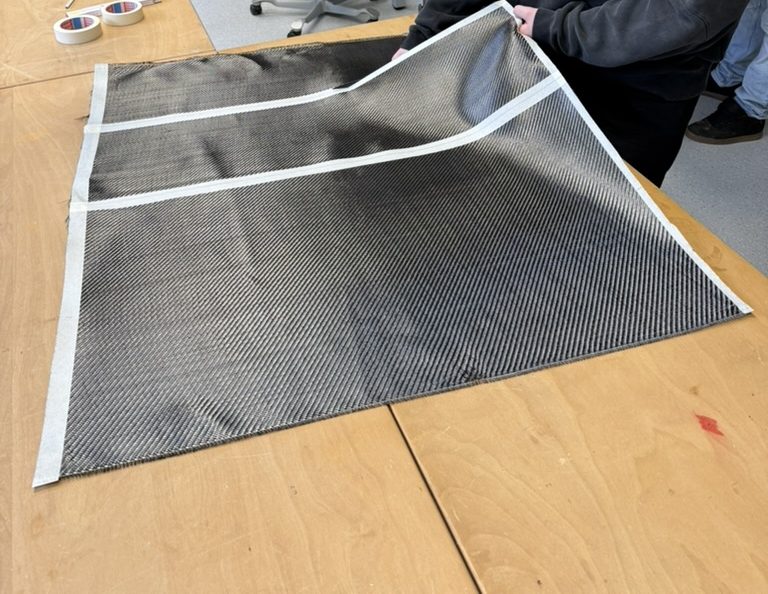
Carbonmatte abkleben vor dem ZuschneidenTaping the carbon mat before cutting
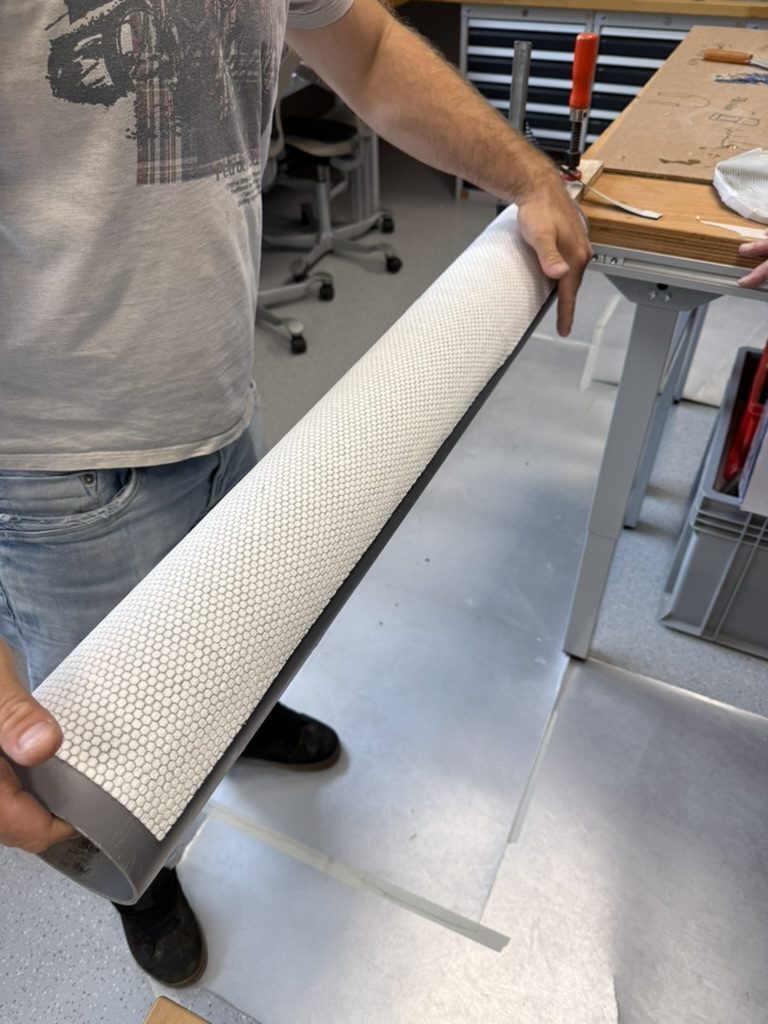
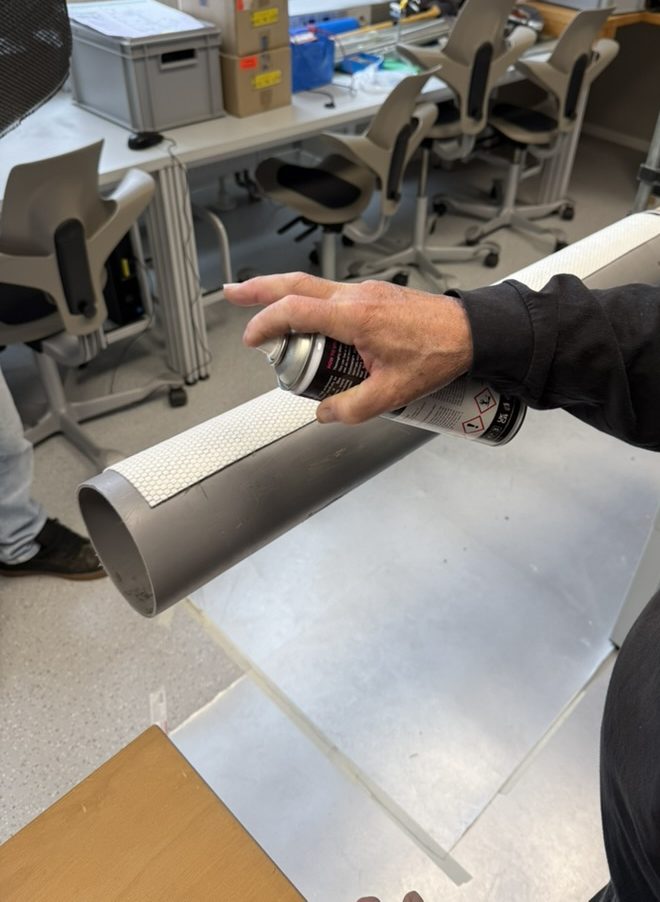
Kern Lantor Soric SF auf dem RohrLantor Soric SF core on the pipe
Kern mit Sprühkleber auf dem Rohr fixierenFixing the core to the pipe with spray adhesive
Harzinfusion: Das Harz fließt in den AufbauResin infusion: the resin flows into the lay-up

Pro Runde

Per round

Runde 1 macht den ganzen Prozess vom Zuschneiden bis zur Infusion. Runde 2 ist kürzer (75 bis 80 min) und arbeitet mit vorgeschnittenen Matten der Vorgruppe.

Round 1 does the whole process from cutting to infusion. Round 2 is shorter (75 to 80 min) and works with mats pre-cut by the previous group.

Sicherheit

Safety

Nitrilhandschuhe, Schutzbrille und Schürzen beim Harz, gute Lüftung. Schutzausrüstung für ca. 12 Personen bereitlegen.

Nitrile gloves, safety glasses and aprons when handling resin, good ventilation. Prepare protective gear for about 12 people.

Ergebnis

Result

Die Blätter sind abends oder am Folgetag fertig. Das montierte Windrad wird den Gästen vor der Abreise gezeigt.

The blades are ready in the evening or the next day. The assembled turbine is shown to the guests before they leave.

Energy market

Yves
Raum 014Room 014

Workshop „European electricity markets: How wind and sun set the price of power“, mit zwei Gruppenaufgaben. Die Folien sind auf Englisch.

Workshop “European electricity markets: How wind and sun set the price of power”, with two group tasks. Slides in English.

DetailsDetails

Ablauf (50 min)

Agenda (50 min)

0–5Einstieg: Schätzfrage zu negativen StrompreisenWarm-up: guessing question on negative prices
5–16Input 1: Markt, Handelsplätze, Merit-OrderInput 1: market, trading venues, merit order
16–26Gruppenaufgabe 1: eigene Merit-Order bauenGroup task 1: build your own merit order
26–33Input 2: Erneuerbare im Markt, Grenzen, AusblickInput 2: renewables in the market, limits, outlook
33–47Gruppenaufgabe 2: Rollenspiel „Ein Sonntag, zwei Preise“Group task 2: role play “One Sunday, two prices”
47–50Abschluss: drei KernbotschaftenWrap-up: three key messages

Vormittags hat Yves die vollen 50 min. Nachmittags sind es 45 bzw. 40 min, dort setzt er die Schwerpunkte selbst.

In the morning Yves has the full 50 min. In the afternoon it is 45 or 40 min, and he sets the priorities himself.

Inhalte

Contents

  • Ein Strommarkt für 27 Länder; Deutschland und Luxemburg bilden eine gemeinsame Preiszone
  • Vier Märkte bis zur Lieferung: Termin, Day-Ahead, Intraday, Regelenergie
  • Merit-Order: Das teuerste noch benötigte Kraftwerk setzt den Preis für alle
  • Mehr Wind, niedrigerer Preis (Merit-Order-Effekt)
  • 2025: Wind und Solar liefern 30,1 % des EU-Stroms, erstmals mehr als alle fossilen Kraftwerke
  • 573 Stunden mit negativem Strompreis in Deutschland 2025
  • Vorteile und Grenzen des gemeinsamen Marktes, Ausblick auf ein komplett erneuerbares System
  • One electricity market for 27 countries; Germany and Luxembourg share one bidding zone
  • Four markets before delivery: forwards, day-ahead, intraday, balancing
  • Merit order: the most expensive plant still needed sets the price for everyone
  • More wind, lower price (merit-order effect)
  • 2025: wind and solar supply 30.1% of EU power, for the first time more than all fossil plants
  • 573 hours with a negative power price in Germany in 2025
  • Benefits and limits of the common market, outlook on a fully renewable system

Gruppenaufgabe 1: Merit-Order

Group task 1: merit order

SzenarioScenarioPreissetzerPrice setter€/MWh
A · Windstiller WinterabendA · Calm winter eveningGas110
B · Windiger SommermittagB · Windy summer middayKernkraftNuclear10
C · Sonniger, windiger SonntagC · Sunny, windy SundayWind / SolarWind / solar≤ 0

Gruppenaufgabe 2: Rollenspiel

Group task 2: role play

Ein Sonntag mit zwei Preisen: um 13 Uhr −50 €/MWh (Strom im Überfluss), um 19 Uhr 180 €/MWh (Strom knapp). Jede Gruppe spielt eine Rolle und rechnet aus, was sie verdient oder spart: Solarpark, Batteriespeicher, Stahlwerk, Haushalt mit E-Auto, Netzbetreiber.

One Sunday, two prices: at 1 pm −€50/MWh (power in abundance), at 7 pm €180/MWh (power is scarce). Each group plays a role and works out what it earns or saves: solar farm, battery storage, steelworks, household with an electric car, grid operator.

Drei Kernbotschaften

Three key messages

  1. Das teuerste benötigte Kraftwerk setzt den Preis für alle.
  2. Wind und Solar bieten fast zum Nullpreis und drücken so den Preis.
  3. Der gemeinsame Markt macht Erneuerbare günstiger und sicherer, wenn Netze und Flexibilität mitwachsen.
  1. The most expensive plant that is needed sets the price for everyone.
  2. Wind and solar bid at almost zero and so push the price down.
  3. The common market makes renewables cheaper and more secure, if grids and flexibility grow with them.

Organisation

Organisation

  • Bei 10 Schülern 2 bis 3 Gruppen à 3 bis 5, gleiche Gruppen für beide Aufgaben
  • Material: Beamer, Papier und Stift pro Gruppe, kein Taschenrechner nötig
  • Brücke zum Windrad: Die Folie „More wind, lower price“ leitet direkt zur Energy tour über
  • With 10 students, 2 to 3 groups of 3 to 5, same groups for both tasks
  • Materials: projector, paper and a pen per group, no calculator needed
  • Link to the turbine: the slide “More wind, lower price” leads straight into the energy tour

Energy tour

Guy Putz
Raum 014 → SchulhofRoom 014 → schoolyard

Die Timeline „20 Jahre Windmobile“, danach das mobile Windrad und der C-Rotor im Schulhof.

The timeline “20 years of Windmobile”, followed by the mobile wind turbine and the C-rotor in the schoolyard.

DetailsDetails

Stationen

Stops

StationStopOrtPlace4530
Timeline 20 Jahre WindmobileTimeline 20 years of Windmobile0142012
Mobiles WindradMobile wind turbineSchulhofSchoolyard129
C-RotorSchulhofSchoolyard139

Minuten je nach Länge der Runde. Das mobile Windrad am besten neben dem C-Rotor aufstellen, dann entfällt ein Weg.

Minutes depending on round length. Ideally set up the mobile turbine next to the C-rotor to save a walk.

Timeline: Eckpunkte

Timeline: key points

2005Gründung von Windmobile als Schülerprojekt2009/10Will Reiter steigt als Werkstattmeister ein2014Besuch bei Enercon2016Erstes Praktikum in Portugal, Start der GSE-Sektion–Zwei selbst gebaute Windkanäle, Modelle, C-Rotor, Piggott-Anlage, Stromvelo202620+ Jahre Windmobile
2005Windmobile founded as a student project2009/10Will Reiter joins as workshop master2014Visit to Enercon2016First internship in Portugal, start of the GSE section–Two self-built wind tunnels, models, C-rotor, Piggott turbine, power bike202620+ years of Windmobile

Zum Mitnehmen

Takeaway

Aus einem kleinen Schulprojekt ist in 20 Jahren eine internationale Gemeinschaft entstanden.

In 20 years, a small school project has grown into an international community.

Räume

Rooms

Raum 013 · Werkstatt Room 013 · workshop Fertigung · 1 Gruppe Manufacturing · 1 group Raum 014 Room 014 Energy market + Timeline Schulhof Schoolyard C-Rotor mob. Windrad mobile turbine nebeneinander, Wechsel in 5 min side by side, 5-minute changeover

Zeitplan

Schedule

Vormittag

Morning

Als TabelleAs a table

Nachmittag

Afternoon

13:30 – 16:30

Als TabelleAs a table

Unterlagen

Documents

Energy marketFolien von Yves, Stand 05.10.2026Slides by Yves, as of 5 Oct 2026
Fertigung RotorblätterRotor blade manufacturingArbeitsblatt und AblaufWorksheet and procedure
folgtcoming soon
Energy tourTimeline 20 Jahre WindmobileTimeline 20 years of Windmobile
folgtcoming soon
Offene PunkteOpen points
  • Raum 014 für den ganzen Mittwoch freimachen lassen, Beamer prüfen. Ansprechperson: Joy Sanchis (?)
  • Start 9:00: Die Präsentationen der Missionen (im Gesamtplan 9:00–9:30) brauchen einen anderen Platz, etwa die Collaboration time 16:30–17:00.
  • Formen: Die letzte Vormittagsgruppe endet 12:30, um 13:30 werden die Rohre wieder gebraucht. Zweiten Satz Rohre als Formen vorsehen.
  • Plan der Partner: Im Gesamtplan steht „Guy & Yves“. Will und Pol für die Fertigung dort ergänzen.
  • Helfer: Schüler aus der Windmobile-Gruppe für Fertigung und Schulhof einteilen.
  • Room 014: have it cleared for the whole Wednesday and check the projector. Contact: Joy Sanchis (?)
  • Start 9:00: the mission presentations (9:00–9:30 in the overall plan) need another slot, e.g. collaboration time 16:30–17:00.
  • Moulds: the last morning group ends at 12:30 and the pipes are needed again at 13:30. Plan a second set of pipes as moulds.
  • Partner schedule: the overall plan says “Guy & Yves”. Add Will and Pol for manufacturing.
  • Helpers: assign students from the Windmobile group to manufacturing and the schoolyard.